
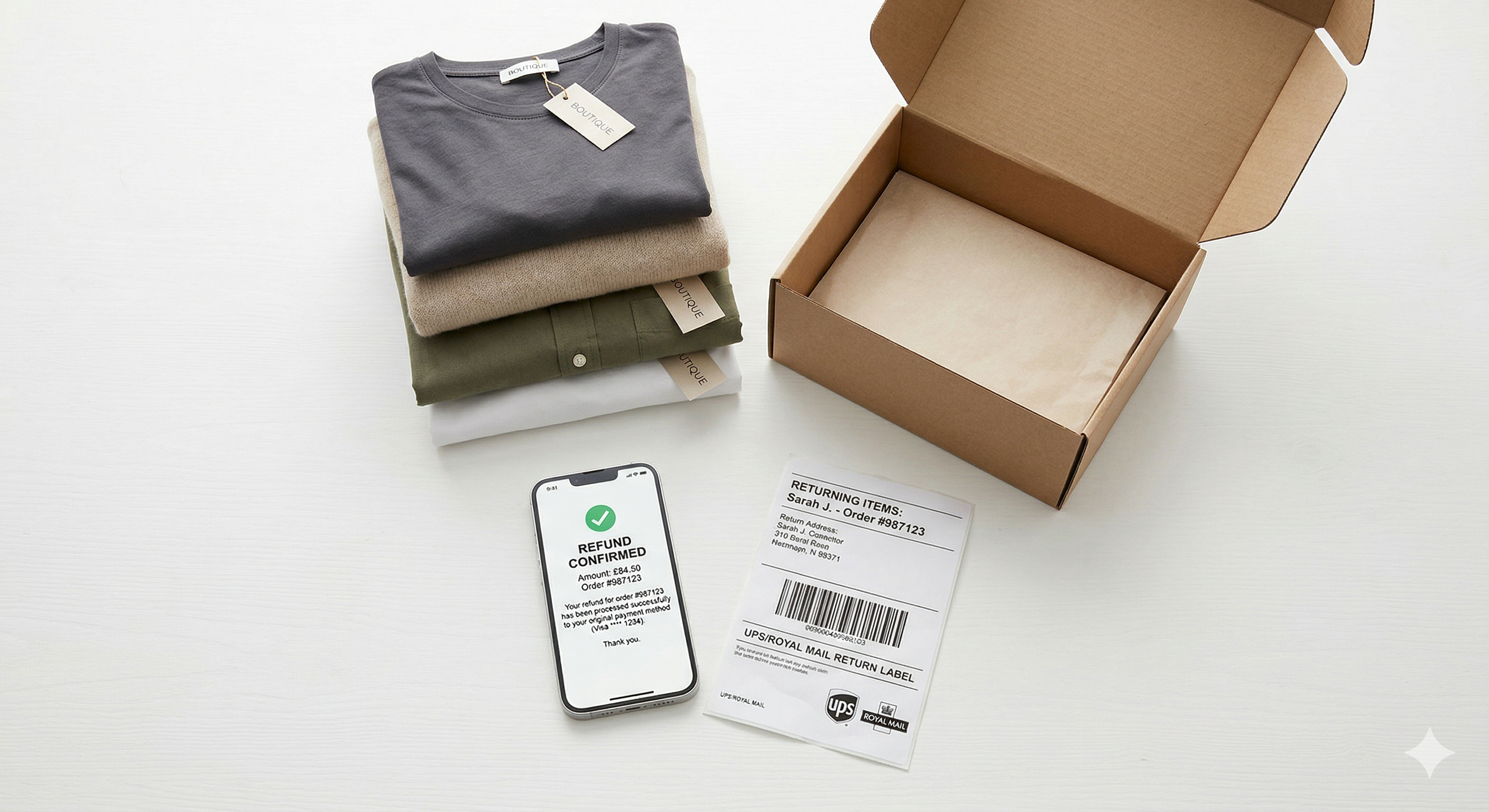

Online clothing stores have a unique set of challenges that most e-commerce advice simply doesn’t account for. A generic “optimise your checkout” guide won’t help you if customers are abandoning because they can’t tell how a shirt fits from a flat-lay photo.
These are the five problems that consistently hurt clothing stores the most — and the concrete fixes that actually work.
1. High Return Rates Driven by Size Uncertainty
The average return rate for online fashion sits between 30% and 40%. The number one reason customers give: the item didn’t fit as expected.
This isn’t a fulfilment problem. It’s a product page problem. When a customer can’t touch fabric, try a garment on, or see how it drapes on a body that resembles theirs, they’re buying on hope. And hope produces returns.
What causes it
- Flat-lay or ghost mannequin photography that doesn’t show real drape or structure
- Size guides that list measurements without helping customers interpret them
- No indication of the model’s size or height relative to the garment shown
- A single product photo showing only one angle
How to solve it
Add body context to every product page. Show garments on multiple body types where possible. Always include the model’s height and the size they’re wearing.
Write a fit note for every product. One or two sentences explaining whether the item runs large, has a boxy cut, or is designed to be worn tucked in gives customers the confidence to size correctly.
Implement 3D garment visualisation. Tools like Vitryne let customers see exactly how a piece fits and drapes before they buy — which directly reduces size-driven returns.
Every percentage point you take off your return rate is pure margin recovery. A store doing $500k/year with a 35% return rate that gets it down to 25% retains roughly $50k in annual revenue without acquiring a single new customer.
2. Low Conversion on Mobile
Fashion is discovered on mobile — Instagram, TikTok, Pinterest — but closed on desktop. When your mobile experience is poor, you’re paying to acquire customers and then losing them at the point of sale.
The average mobile conversion rate in fashion e-commerce is around 1.2–1.5%, roughly half the desktop rate. The gap isn’t inevitable.
What causes it
- Product images that are too small or don’t support pinch-to-zoom
- Checkout flows with too many form fields
- Pop-ups and banners that dominate the screen on small devices
- Slow page load times, often caused by unoptimised images
How to solve it
Prioritise image quality on mobile. Enable pinch-to-zoom. Use square or portrait-oriented images that fill the screen rather than landscape shots that shrink to thumbnails.
Reduce checkout friction. Enable Shop Pay, Apple Pay, or Google Pay — one-tap checkout eliminates the form-filling that causes the most mobile drop-off. Every extra field is a leak.
Audit your page speed. Use WebPageTest or Google PageSpeed Insights on your mobile experience specifically. Compress images to WebP. Lazy-load anything below the fold. A one-second improvement in load time can lift conversion by 7%.
Test every pop-up on mobile. Email capture pop-ups that look reasonable on desktop often cover the entire screen on mobile. If a visitor can’t easily close it, they leave.
3. Product Pages That Don’t Convert
A customer lands on your product page from an ad. They scroll. They leave. You’ve paid for that click and got nothing.
Product page conversion in fashion averages 2–3%. Stores that invest in their product pages consistently outperform this — often reaching 5–8% on their best-performing items.
What causes it
- Descriptions that list fabric composition but say nothing about how the garment feels or who it’s for
- A single hero image with no supporting shots
- Social proof that’s absent, buried, or unconvincing
- No clear signal of scarcity or urgency where relevant
How to solve it
Rewrite your descriptions for the customer, not the warehouse. Fabric content belongs in a collapsible spec section. The main description should answer: what does this feel like, how does it wear, and why would I want it?
Build a shot list for every product. Front, back, side, detail close-up, worn flat, worn styled. If budget allows, add video. Customers who view a video are 64% more likely to purchase.
Make reviews prominent and specific. Aggregate star ratings are weak signals. Feature written reviews that mention fit, fabric feel, and whether the reviewer sized up or down — these answer the questions a spec sheet can’t.
Use low-stock indicators honestly. “Only 2 left in size M” is a legitimate conversion driver when it’s true. Don’t manufacture artificial urgency — it damages trust the moment a customer notices.
4. Poor Inventory Management Leading to Overselling and Stockouts
Nothing damages customer trust faster than confirming an order and then emailing to say the item is out of stock. It happens more often than it should, and the damage compounds: the customer asks for a refund, leaves a negative review, and tells their friends.
What causes it
- Selling across multiple channels (your website, a marketplace, a physical store) without synced inventory
- Manual stock updates that lag behind actual stock levels
- No buffer stock logic for fast-moving sizes
- Variants (size S in black) tracked less carefully than top-level products
How to solve it
Centralise inventory in a single source of truth. If you’re selling on Shopify and at a market stall simultaneously, your Shopify stock levels will drift unless you’re using a point-of-sale system that syncs in real time. Most modern POS tools — including Shopify POS — solve this if properly configured.
Set up low-stock alerts by variant. The medium in your bestselling colourway will sell out before the XL in a colourway nobody wants. Alerts at the variant level, not the product level, are what prevent stockouts that matter.
Build a buffer into your published stock. For your highest-velocity items, hold back a small reserve before you mark a variant as sold out. This buys you time to process pending returns that will restock those sizes.
5. A Weak Post-Purchase Experience That Kills Repeat Business
The average fashion brand spends heavily to acquire customers and almost nothing to retain them. Given that a repeat customer spends 67% more per order than a first-time buyer, this is one of the most expensive mistakes a store can make.
What causes it
- A transactional confirmation email with no brand voice, no next step, and no incentive to return
- No post-delivery follow-up asking about the fit experience
- Loyalty programmes that are either non-existent or too complicated to use
- Returns processes that are punishing enough to ensure the customer never comes back
How to solve it
Treat your post-purchase email sequence as a brand touchpoint. The confirmation email gets the highest open rates of any email you’ll ever send. Use it. Include styling suggestions for what they just bought, a clear returns policy, and a soft prompt to follow you on social.
Send a fit check email 5–7 days after delivery. Ask how the fit was. Route dissatisfied customers to an easy exchange flow before they reach for a return label. This single email, properly set up, can cut return rates by 10–15%.
Make returns frictionless — on purpose. It feels counterintuitive, but a painless return experience is one of the strongest drivers of second purchases. Customers who have a good return experience trust you enough to order again. Customers who don’t, never come back.
Build a simple loyalty mechanic. Points-per-purchase, early access to new drops, or a referral discount — choose one and implement it well rather than building something complex that nobody uses.
The Common Thread
Each of these five problems comes back to the same underlying issue: online shopping asks customers to make a commitment — spending money, waiting for delivery — without being able to experience the product first.
Every improvement you make to your product pages, your fit communication, your returns process, and your post-purchase follow-up is an investment in reducing that gap. The stores that close it consistently outperform those that don’t.
Vitryne tackles the hardest part of that gap directly: 3D garment visualisation that shows customers exactly how a piece fits and drapes on a body like theirs — before they buy. It reduces return rates and increases conversion at the same time.